
Key Points
The first framework for Ronin Governance is almost here: RON holders will soon be able to vote on economic and treasury decisions that impact our ecosystem. While this scope can increase over time, protocol and security-critical decisions remain under validator governance for now.
RON holders: Cast your first vote soon! The RGP-1 proposal process is set to begin in October. This will determine whether treasury assets will become liquidity for RON/WETH and RON/USDC pools on the Katana DEX.
Proof of Distribution <> RON Conviction Update: Starting September 10th, we’ve applied a new weight on Builder Scores. RON Conviction rewards communities that show conviction in RON. More details below.
A new era for Ronin has begun.
Markets are heating up. Proof of Distribution is improving in real-time. Soon, RGP-1 will usher in even more new possibilities for our ecosystem.
Ronin Governance will give RON holders a stronger voice in the future of our ecosystem. You’ll be able to engage in proposal crafting, cast votes based on RON holdings, and see how the ecosystem transforms as a result. Here’s what’s happening:
A new role for RON holders
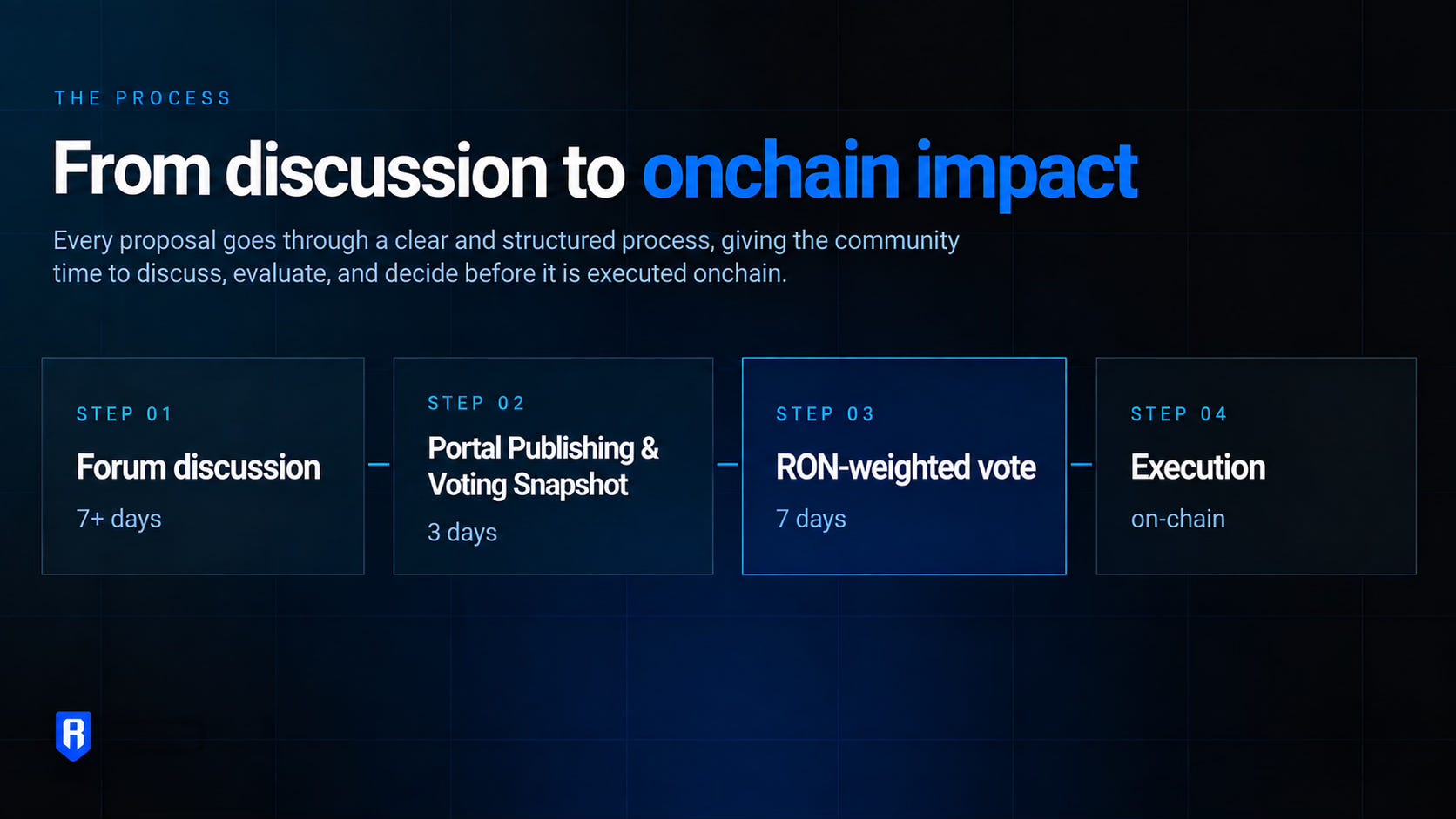
Governance gives YOU the power to participate in shaping Ronin. Vote on proposals based on how much RON you hold. 1 RON = 1 Vote. A supermajority of 66% is necessary for a proposal to pass.
The Ronin Ecosystem team has built a simple four-step process to introduce our first proposal, which focuses on improving liquidity on Ronin via deployment of Ronin Treasury funds.
RGP-1: Putting the Treasury to Work
RGP-1 is a proposal to deploy treasury assets as liquidity for RON/WETH and RON/USDC on Katana. If passed, RON markets would deepen, price discovery would become easier, and slippage would decrease. More liquidity, more efficiency. This would also generate more trading fees for the treasury as activity grows.
Note: Existing treasury reserves would fund RGP-1, and any future top-ups generated through the ecosystem’s liquidity would follow parameters approved through governance.
Looking Ahead: Funding the Ronin Treasury
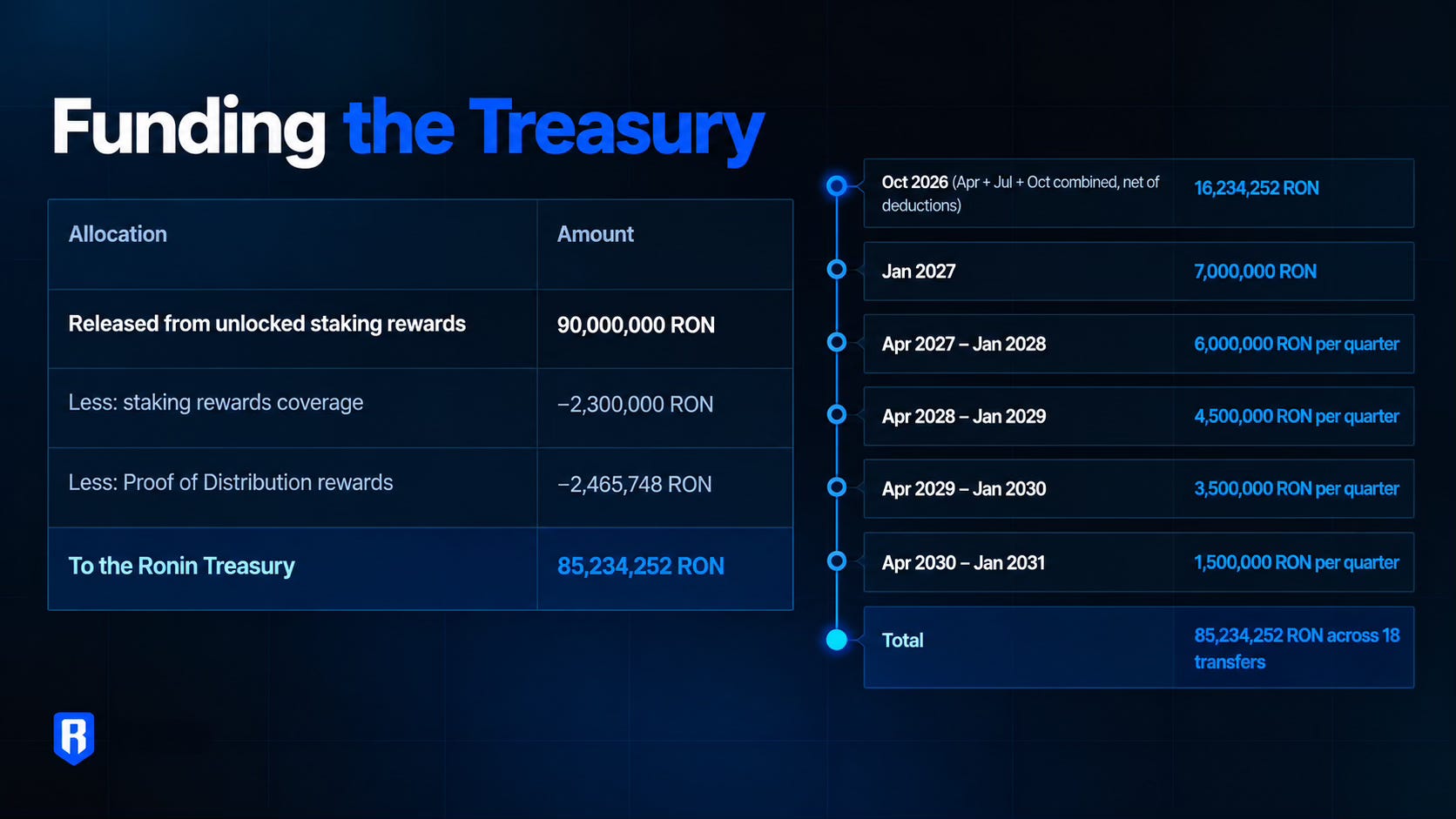
Earlier this year, the Ronin Ecosystem team announced that 90M RON in staking rewards would flow back into the ecosystem. That’s why the Ronin Ecosystem team will transfer a first tranche of 16,234,252 RON to the treasury in October. The remaining transfers will follow the schedule below, which will follow a fixed quarterly distribution that tapers until January 2031.
The October transfer combines tranches from April, July, and October while subtracting the ~ 2,456,748 RON paid out in PoD rewards. In total, 85,234,252 RON will flow from former staking rewards to the Ronin Treasury.
Note: Some of the 90M RON will flow to Proof of Distribution rewards without ending up in the treasury. See the chart above for exact figures.
New Update: RON Conviction<> Proof of Distribution
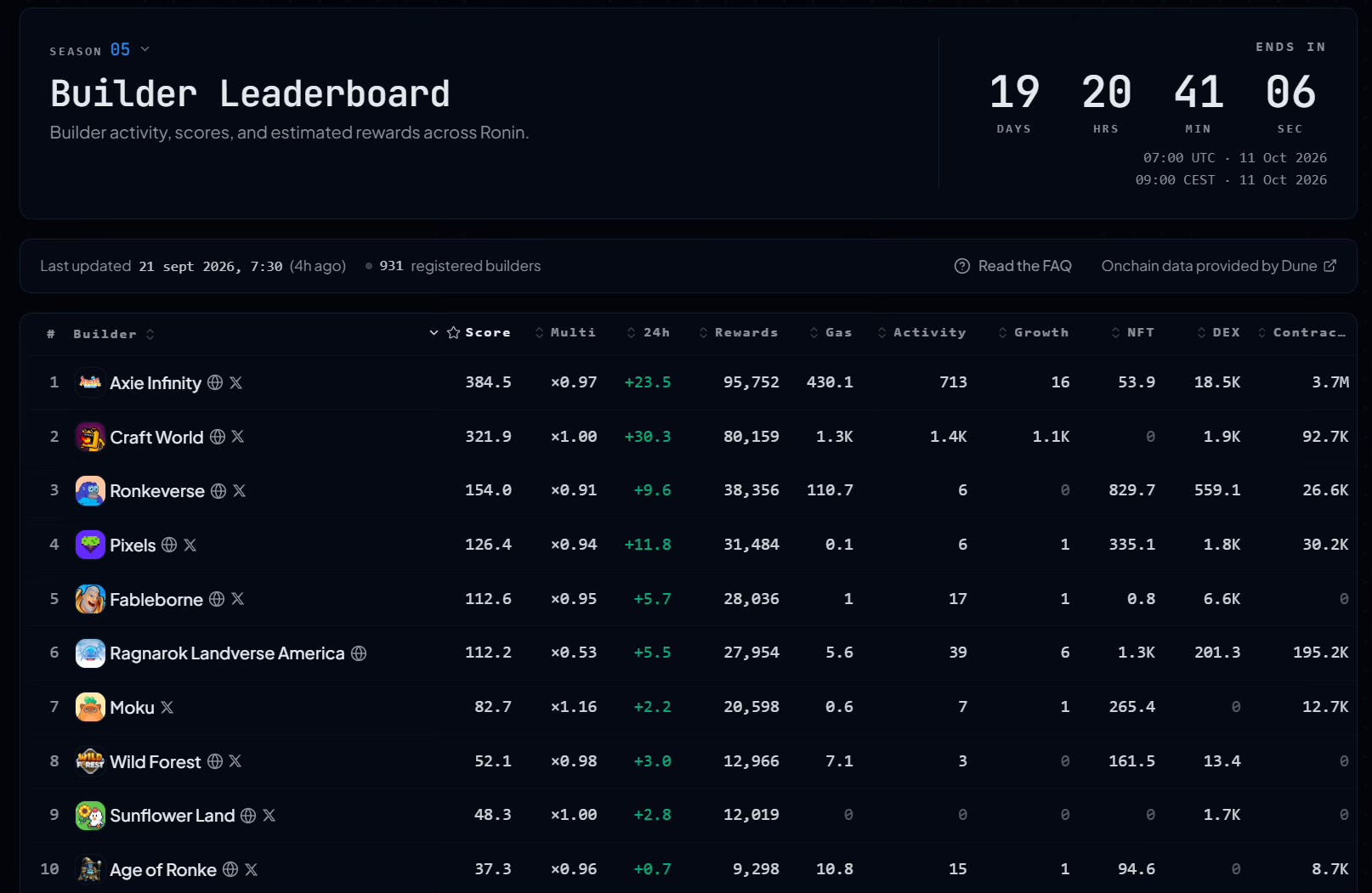
RON Conviction is a new Builder Score multiplier we’re applying to Proof of Distribution rewards. Think of it like a multiplier that rewards builders with strong communities while dampening rewards for builders with low-conviction communities.
More RON conviction → Higher RON Conviction multiplier → More PoD Rewards
Low RON conviction → Lower RON Conviction multiplier → Fewer PoD Rewards
Imagine Ronke has a Builder Score of 700 and a RON Conviction multiplier of 1.1. In the past, their final Builder Score would be 700. Starting today, it would be 770 because 700 x 1.1 = 770.
This increases Ronke’s total RON rewards from PoD.
Or, think of a team with a Builder Score of 300 but a RON Conviction multiplier of 0.8. In the past, their final Builder Score would be 300. Starting today, it would be 240 because 300 x 0.8 = 240.
This decreases their total RON rewards from POD.
This is the formula we’ll use for now:
1 + net conviction / (gross conviction + K)
• Net: RON or wRON bought or sold by builder’s users (trailing 30 days)
• Gross: Total RON or wRON traded
• K: Median trading volume across ALL active builders
Note: Why use the median trading volume (K) as a variable? Because RON Conviction should take into account conviction relative to the entire market. If one person acquires 1 RON and swaps 0 RON, that does not indicate high conviction. However, if they acquire 1,000,000 RON and swap 0 RON, that indicates very strong conviction. Without K, both of those actions would have the same weight because the ratio would be 1:0.
What is Honor Score?
The Ronin Ecosystem team is also developing Honor Score, which is a way to measure user contribution across the Ronin ecosystem. Think of it like this: Builder Score highlights builder reputation, Honor Score highlights user reputation. For example, users who make meaningful contributions to our ecosystem will get a higher Honor Score.
This will give builders better data about the users interacting with their products, which in turn helps them understand their communities, identify highly engaged users, and make better decisions around rewards, experiences, and ecosystem incentives.
We’ve already seen this work: The Ronin Ecosystem team used an early version of Honor Score to identify 1,000 Ronin users for the Yakkamon free mint, helping connect an ecosystem opportunity with users who were already contributing to Ronin.
Over time, Honor Score will unlock additional utility for users across the ecosystem. As new use cases are introduced, we’ll gradually reveal how your Honor Score can become a more meaningful part of your onchain identity and experience.
The same principle that powers Proof of Distribution applies here: what YOU do on chain matters. Welcome to Ronin Governance.
FAQ Part 1
Q1: Why is the treasury transfer taking roughly five years?
The schedule follows Ronin’s whitepaper, tokenomics, and vesting schedule, which include RON that has yet to be unlocked.
The good news is that once this RON is unlocked, it will go directly to the treasury. This means the treasury will continue receiving RON as the remaining tokens are released according to the established schedule.
Q2: If 1 RON = 1 Vote, what’s stopping someone from buying a lot of RON and forcing or blocking proposals?
You’ll only be able to vote on proposals that come out of forum discussions and a temperature check by the Ronin Ecosystem team. This removes the risk of reckless proposals getting passed. Once voting begins, the supermajority requirement also increases the amount of RON required to single-handedly influence a vote. After internal analysis, the Ecosystem Team has identified that it’s unlikely that there are meaningful takeover risks as a result. If issues do arise, the governance framework can also be adjusted.
FAQ Part 2
Q3: Does this proposal only affect $RON? How are we going to provide liquidity if we've already used our WETH/USDC on RON buybacks in the past?
The Treasury still receives ongoing WETH/USDC inflow, and currently holds approximately $100k in WETH/USDC. That's what would fund this proposal's liquidity.
Q4: Will this only use single-sided liquidity?
No. This uses a standard two-sided liquidity pool.
Q5: Why was this decided for the Treasury without any community discussion first?
This is a proposal, not a decision. If the governance vote rejects it, it won't happen. That's why it's being put to a vote rather than implementing it directly.
Q6: As an individual who holds RON, why should I care about voting?
Voting gives you real influence over the ecosystem. This is the first proposal. RGP-1 activates treasury funds, and a future proposal could modify PoD or Honor Score mechanics, which directly affects how you earn rewards. Your vote shapes decisions for the ecosystem, it's not just treasury management.
Q7: Using the treasury to deepen liquidity pools reduces the fees earned by people and groups already providing liquidity. Why should I care whether the treasury earns fees from liquidity?
If you don't want the treasury earning fees this way, that's what the vote is for, vote against the proposal. If it passes, the fees that the treasury earns go back into the ecosystem productively, rather than treasury funds sitting idle. You decide.
Q8: Why not include $RON holdings in the Honor Score calculation?
We're still working through this one. Ronin doesn't have RON staking, so there's no direct 1:1 comparison. How RON holdings might factor into your score, if at all, is an open question we think deserves broader discussion internally and with the community before we commit to an answer.
Q9: How can I check my Honor Score?
You can view your honor score here: https://pod.roninchain.com/honor